Article: THE DE BORGHT building - a brief history
THE DE BORGHT building - a brief history
After 25 years at DE BORGHT in another historic building in Guldenstraat, we moved our shop to Goswin de Stassartstraat, number 11. The place we can now call our second home, where we bring interior dreams to life and where we as a team can work together every day.
But before we settled into this gigantic city palace, with its stunning, well-known chapel, this building had already witnessed a rich history. It's a long history, but we'd be happy to tell it briefly.
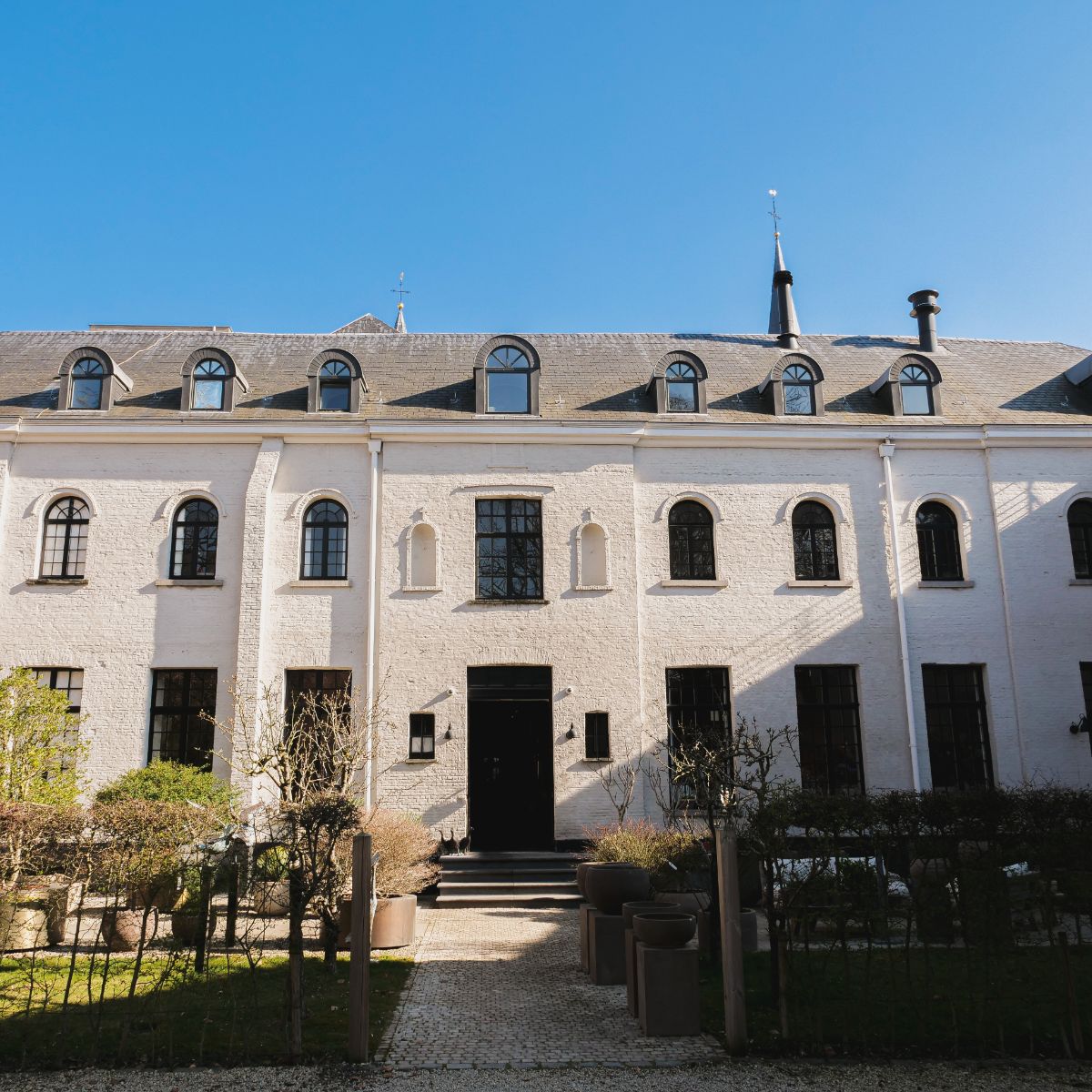
The 'Hotel Van der Gracht de Rommerswael', also known as 'Hof van Wachtendonck' or more recently as 'Home Astrid', is a city palace with a centuries-old history.
The oldest documents found about this property date from the end of the 16th century when William of Orange had taken Mechelen. Jan van Leyen, a Catholic benefactor and wealthy Antwerp entrepreneur, bought this developed plot in 1581 with two adjoining houses: the small house (left) and the 'Groothuys' (right).
This domain was part of an elite district of Mechelen which housed several refuges, some prominent abbeys, and residences of archdukes and jurists of the Great Council of the Netherlands (the highest court of justice).
In 1606, it was sold by the widow Leyen, and the domain experienced a turbulent period, during which it was sold, rented, split, rejoined multiple times, debts were not repaid, and so on. During that period, the pastor of St. John's Church, among others, lived here.
In 1649, the 'certain large and convenient house' was publicly sold to Joannes van Wachtendonck, a wealthy priest (a provost) who descended from an aristocratic family from Gelderland, and one of the eight spiritual councillors of the Great Council. He probably also added the beautiful facade to the house. 'Jean de Wachtendonck' was appointed bishop of Namur in 1651 and archbishop of Mechelen in 1667, but he died before he could take possession of his seat.
The city palace came into the hands of his nephew: Franciscus Cosmas van Wachtendonck, who was mayor of Mechelen and married to Philippina Van der Gracht de Rommerswael. Their son Jean-François remained childless, and after his death in 1751, it came into the hands of his brother-in-law, Baron Roger Phillippe Van der Gracht de Rommerswael, lord of Vremde and Battenbroeck, who later also bought the corner house at Stassartstraat 9.
At the beginning of the 19th century, the building came into the hands of two unmarried daughters of the Van der Gracht de Rommerswael family, Albertine and Louise, who had the corner house (no. 9) demolished and a contemporary house built there, where they lived and sold the city palace.
Thus, in 1840, the property became owned by the Poor Clares, who built a new wing and a chapel in 1844 (after purchasing another narrow house on the right), and so the old city palace became a place of silence and prayer: a monastery with a central courtyard, cloister walk, and on the first and second attic floors, monastic cells for the sisters. In the annex, the Poor Clares-Colletines also organized a small school: "l'école des pauvres filles". In 1966, the Poor Clares left the property and the city.
In 1970, Mariette Janssen converted the monastery into a nursing home 'Home Astrid' (named after the previous house on Astridlaan in Mechelen), where the monastic cells were furnished as rooms for the elderly. Until 2015, it was run by Mariette, her daughter, and granddaughters as a luxurious retirement home.
After an intensive renovation, under the expert guidance of Veerle Van Eycken, the doors reopened in April 2016. Today, this city palace houses the decoration and flower shop DE BORGHT and the student house Home Astrid.
Meanwhile, we have been enjoying this location for a good five years now and are thoroughly enjoying the property.